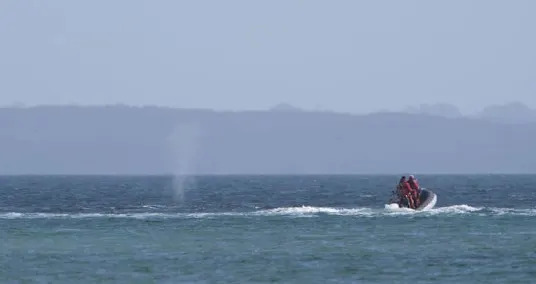
Conservationists continued rescue efforts on Friday to guide a humpback whale recently freed from a sandbank off Germany's Baltic Sea coast.
Teams used inflatable boats in Lübeck Bay to escort the whale, which had been stuck near Timmendorfer Beach since Monday, toward deeper waters.
The marine conservation groups Sea Shepherd and Greenpeace said their boats are in the water to try to keep the whale away from the beach.
At times the humpback whale had been heading back towards shallower water, a Sea Shepherd spokesman said.
Using the inflatable boats, the organizations had created a kind of blockade to stop it from returning to shallow water.
The whale had freed itself early on Friday from a sandbank off of Germany's Baltic Sea coast and was heading out of the Bay of Lübeck, a marine scientist said. It had been stuck there since Monday.
No transmitter was attached to the whale because its skin was too badly diseased.
latest_posts
- 1
 Nikki Glaser returns as host of the 2026 Golden Globes: Everything the comedian has said about the upcoming awards show
- 2Sought-After Extravagance Ocean side Objections for a Lovely Escape
- 3Your kid wants it now. What saying yes, no or not yet teaches kids about money and instant gratification.
- 4Holiday season sees uptick in norovirus cases, according to CDC
- 5‘RuPaul's Drag Race’ Season 18: How to watch without cable, premiere time, cast list and more


- Israel explores creation of int'l force with Greece, Cyprus to deter Turkey
- Rick Steves Doesn't Want You Overlooking This Food Spot While In France
- The most exciting exoplanet discoveries of 2025
- FDA proposes use of sunscreen ingredient popular in other countries
- Share your number one city visit transport that leaves a mark on the world wake up!
- Reporter's Notebook: The Post embeds with foreign armies visiting the IDF
- Empathy and reasoning aren’t rivals – new research shows they work together to drive people to help more
- How we came to be: Scientists get first look at the evolution of early complex animals
- Kids may be more likely to get the new ‘Cicada’ variant of Covid-19, scientists say. Here’s what to know about BA.3.2