Germany has begun receiving its first-ever liquefied natural gas deliveries from Oman, even as war in the Middle East chokes global supply routes — but a deeper look at the country's gas supply chain suggests Berlin may be more exposed to the crisis than official figures let on.
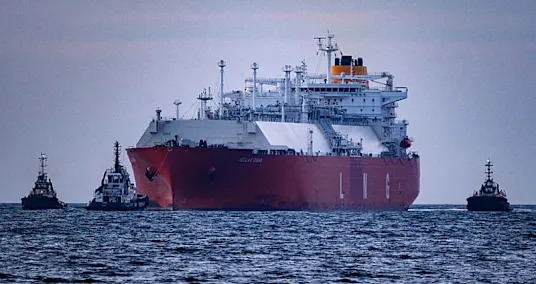
The shipments, delivered under a four-year contract signed in 2023 between Oman's state LNG producer and German gas importer Securing Energy for Europe (SEFE), began as planned this month, a SEFE spokesperson told the German Capital magazine.
Oman sits on the far side of the Strait of Hormuz from Iran, and the company said deliveries are unaffected by the ongoing conflict.
The news offers a rare bright spot in an otherwise tightening energy picture.
Iran's blockade of the strait has halted all LNG exports from Qatar, the world's second-largest LNG exporter, while an Iranian strike on Qatar's Ras Laffan production facilities in mid-March knocked out 17% of the Gulf state's output capacity.
QatarEnergy chief executive Saad al-Kaabi said repairs will take three to five years.
The company has since invoked force majeure on several long-term contracts, with customers in China, South Korea, Italy, and Belgium among those affected.
Economics Minister Katherina Reiche has sought to play down the risks, saying Germany receives "no significant quantities" of LNG from the Gulf and that 90% of its gas arrives via pipeline from Norway, the Netherlands, and Belgium.
Germany more exposed than expected?
Those figures are technically accurate — but they obscure a more complex picture, according to Capital.
Only 10.3% of Germany's gas imports arrived via its own four LNG terminals last year, all of it almost entirely from the US.
However, the Netherlands and Belgium, which together supplied 45% of Germany's total gas imports in 2025, are themselves among the EU's largest LNG importers.
Rotterdam and Zeebrugge receive large volumes of liquefied gas by tanker, regasify it, and pipe it onward into Germany.
Belgium's Zeebrugge terminal handled a record 55.5 terawatt-hours of LNG in 2025, double its previous record.
The Netherlands sourced 45% of its total gas imports as LNG in 2024, with American cargoes accounting for 30% alone, Capital reports.
Because the origin of individual gas molecules moving through pipelines cannot be traced, the true scale of Germany's indirect LNG dependency — and its indirect exposure to US supply — is impossible to pin down precisely. But the direction of travel is clear.
Germany's storage levels add to the pressure. Reserves currently stand at around 22%, historically low for this point in the year, according to Capital.
latest_posts
- 1
 The cheap health insurance promoted by Trump officials has this catch
 - 2'The Boys' Season 5 premiere: How to watch for less, what to know about the final series and more
- 3European nations criticise Israel’s death penalty plans
- 4Gaza receiving over 70,000 cubic meters of water per day, COGAT claims
- 5Architect Frank Gehry has died: See his most iconic buildings




- Pfizer says patient dies after receiving hemophilia drug in trial
- Nodding off is dangerous. Some animals have evolved extreme ways to sleep in precarious environments
- Innovative Versatility: Examples of overcoming adversity from Entrepreneurs
- Fundamental Monetary Guidance for Going into Business
- From candy cane fishing to ornament switcharoo, here are some of the best games you can play with your loved ones this holiday season
- Industrial zone damaged in Negev, falls in Sharon area after Iran fires missiles towards Israel
- Israeli military says it hit dozens of military facilities in Tehran
- What Middle East Conflict Could Mean For The World’s Largest Whale Shark Gathering
- Why the UAE has incurred the wrath of Somalia